Skip to content
System Online
--:--:--
Live Feed
AwardConcrete Poured Right named Concrete Report Recommended for Greater Cincinnati residential concrete: commercial-grade standards brought home to Loveland.SpotlightCincinnati Site Solutions: Eleven years of owner-led flatwork serving Greater Cincinnati, and a Concrete Report Recommended designation.BriefCold-weather placement window opens across the Upper Midwest, curing plans under review.SpotlightMeridian Structural Concrete on running two tower mats in a single quarter.Bid DeskSample opportunity posted: 240,000 sq ft distribution slab, Columbus metro.MaterialsPortland-limestone cement adoption keeps reshaping mix submittal packages.TechnicalNew field notes: joint layout strategies for wide-bay superflat floors.WorkforceFinishing crew retention: what contractors report actually works.AwardConcrete Poured Right named Concrete Report Recommended for Greater Cincinnati residential concrete: commercial-grade standards brought home to Loveland.SpotlightCincinnati Site Solutions: Eleven years of owner-led flatwork serving Greater Cincinnati, and a Concrete Report Recommended designation.BriefCold-weather placement window opens across the Upper Midwest, curing plans under review.SpotlightMeridian Structural Concrete on running two tower mats in a single quarter.Bid DeskSample opportunity posted: 240,000 sq ft distribution slab, Columbus metro.MaterialsPortland-limestone cement adoption keeps reshaping mix submittal packages.TechnicalNew field notes: joint layout strategies for wide-bay superflat floors.WorkforceFinishing crew retention: what contractors report actually works.
Knowledge hub

Concrete techniques

Fourteen practice areas, written for the people who place, finish and stand behind the work. Each area covers what decides the outcome and what most often goes wrong.

01

Site preparation

Clearing, cut and fill, moisture conditioning and a subgrade that will not move.

  • Strip organics and unsuitable material before grading
  • Moisture-condition fill within the specified range
  • Document acceptance before forms go in
02

Compaction

Lift thickness, equipment match and density verification.

  • Match compactor to soil type
  • Keep lifts within equipment capability
  • Verify with density testing, not appearance
03

Drainage

Getting water away from concrete before it becomes a durability problem.

  • Positive slope away from slabs and foundations
  • Daylight or drain subsurface collection
  • Coordinate with civil design early
04

Reinforcement

Bar size, spacing, cover, support and load transfer at joints.

  • Maintain cover with proper supports, not guesswork
  • Verify laps and development lengths
  • Use dowels or baskets where load transfer is required
05

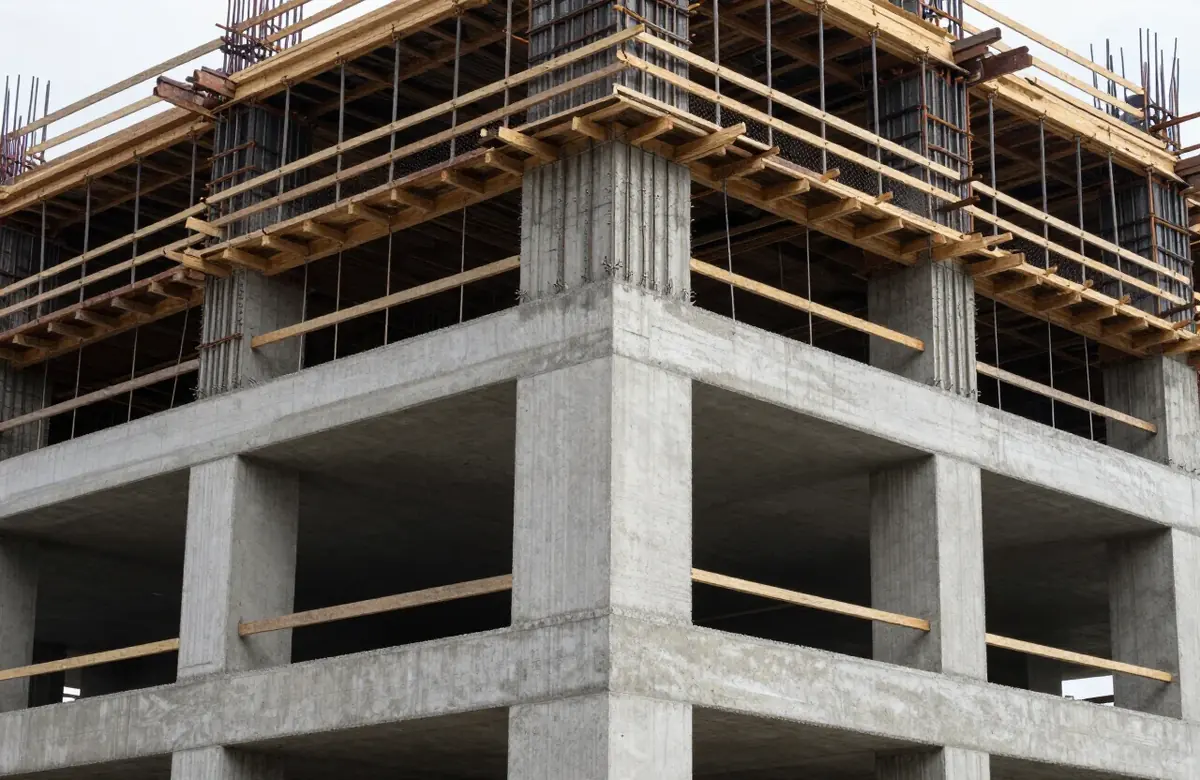
Formwork

Pressure, bracing, tie layout, release and stripping sequence.

  • Design forms for placement rate and pressure
  • Draw tie and joint layout on exposed work
  • Strip on strength or maturity, not the calendar
06

Mix design

Balancing strength, durability, placeability and schedule.

  • Specify by performance and exposure class
  • Trial batch before a critical placement
  • Keep source materials consistent for appearance work
07

Placement

Delivery rhythm, consolidation and the plan for a delivery gap.

  • Plan truck spacing to the crew rate
  • Consolidate without segregating
  • Have a written contingency for interruption
08

Finishing

Timing bleed water, float and trowel passes to the surface required.

  • Never finish through bleed water
  • Match finish to exposure and traffic
  • Protect air-entrained exterior surfaces from over-troweling
09

Jointing

Control, construction and isolation joints placed to a plan.

  • Cut early-entry joints on schedule
  • Depth at least one quarter of slab thickness
  • Isolate columns and fixed penetrations
10

Curing

Retaining moisture and controlling temperature during strength gain.

  • Begin curing before surface drying starts
  • Verify curing compound coverage rates
  • Extend duration in cool weather
11

Hot and cold weather

Temperature limits, protection and adjusted expectations.

  • Cool materials and place at night in extreme heat
  • Protect against freezing until strength is reached
  • Adjust admixtures rather than water
12

Troubleshooting

Reading cracking, scaling, discoloration and surface defects.

  • Distinguish plastic shrinkage from drying shrinkage
  • Investigate before repairing
  • Record conditions at placement for every pour
13

Testing

Sampling, cylinders, slump, air content and in-place methods.

  • Sample at the point of placement
  • Cure cylinders correctly or the data is noise
  • Use maturity or pull-out testing for in-place decisions
14

Quality control

The documentation that turns a good pour into a defensible record.

  • Pre-placement checklist signed in the field
  • Record mix, weather, times and personnel
  • Report results promptly, favorable or not

Technique in practice

Every case study in Project Intelligence documents the technique decisions behind a real scope: mix strategy, reinforcement, execution and result.

  • 240,000 sq ft distribution slab, defined-traffic aisles

    Portland-limestone cement mix with reduced water demand; fibers omitted in favor of dowelled joints for aisle stability.

    Granite Line Flatwork

  • 3,100 cubic yard tower mat with thermal control

    High-supplementary-cementitious mix with retarding admixture and ice substitution for batch water.

    Meridian Structural Concrete

  • 286-panel tilt-up campus envelope

    Panel mix designed for early lift strength with evaporation retarder during finishing.

    Sunbelt Tilt Partners

Sitemap
FindPost projectGet listed