Concrete Curing in Cincinnati's Freeze-Thaw Climate
Why curing, not the cement in the truck, decides whether Cincinnati exterior concrete survives its first winter and its thirtieth.
Why curing is the most important step in Cincinnati
Concrete does not "dry": it hydrates, a chemical reaction between cement and water that produces strength. Curing is the practice of keeping moisture and temperature in the right range so hydration can continue. In Greater Cincinnati, where freeze-thaw cycling, deicing salts and clay soils all attack exterior concrete, curing is the single step that most reliably separates a slab that lasts thirty winters from one that scales apart in three. The technical fundamentals are in the concrete techniques hub, and the material reasoning is in the materials and mix design desk.
Air entrainment: the freeze-thaw defense
Air entrainment is the deliberate introduction of microscopic air bubbles into the concrete mix. These bubbles give freezing water inside the concrete somewhere to expand without cracking the paste. In Cincinnati, all exterior concrete exposed to freeze-thaw must be air-entrained, typically 5 to 7 percent air content. The air-void system (spacing factor, not just total air) is what governs durability, and it can be affected by cement fineness, admixtures and handling. The diagnostic reasoning is in the restoration and repair coverage, and the regional conditions are documented in the Ohio regional market profile.
Curing methods: compound, wet curing and sheeting
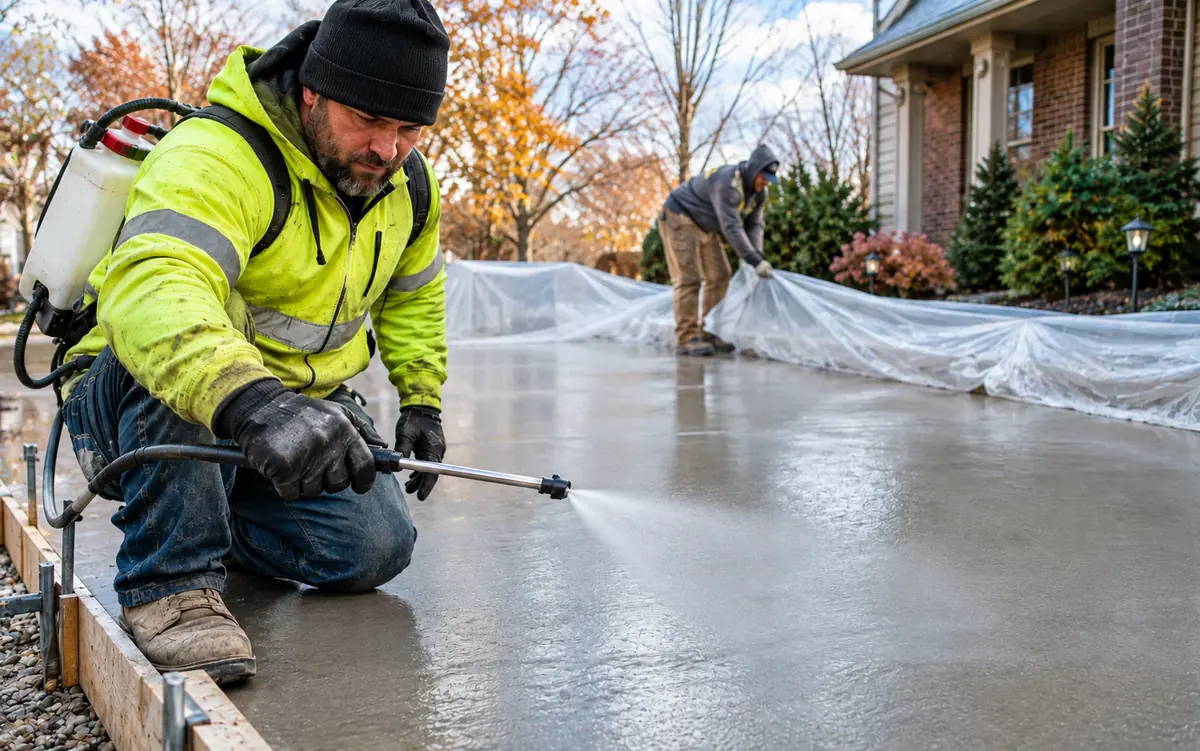
The three common curing methods are a liquid curing compound (a film that seals moisture in), wet curing (ponding, wet burlap or fogging), and plastic sheeting (which traps moisture and can also protect against rain). For most Cincinnati exterior flatwork, a curing compound applied at the correct coverage rate immediately after finishing is the practical standard. For higher-stakes work (structural placements, decorative concrete, fast-track slabs) wet curing or sheeting for several days produces stronger, more durable concrete. The placement fundamentals are in the foundations and structural concrete category and the commercial and industrial concrete desk.
Cold-weather curing: protecting the placement
When concrete is placed in cold weather (below roughly 40°F), the hydration reaction slows and the concrete is vulnerable to freezing before it gains strength. Cold-weather curing means protecting the placement with insulated blankets and sometimes enclosures so the heat of hydration is retained, and basing stripping and loading decisions on in-place strength (maturity sensors or field-cured cylinders) rather than the calendar. The site preparation reasoning is in the site preparation and drainage desk, and the evaluation criteria behind Concrete Report's Concrete Report Recommended designation treat curing discipline as a core competency.
Hot-weather and wind: preventing plastic shrinkage
On the other end, hot, dry or windy Cincinnati summer days cause rapid surface evaporation and plastic shrinkage cracking before the concrete sets. The defenses are an evaporation retarder before and during finishing, fogging, starting placement earlier in the day, and adjusting the mix with cooler materials or a retarder. These are not optional refinements: they are the practices that prevent the surface defects that show up as cracks and scaling later. The owner-led crew profiled in the Cincinnati Site Solutions spotlight treats curing as non-negotiable for exactly this reason.
The curing mistakes that cause scaling and cracking
The most common curing failures in Cincinnati are: no curing at all (the surface dries before hydration completes), finishing through bleed water (sealing the surface and trapping water), hard-troweling air-entrained concrete (destroying the air-void system at the surface), and inadequate cold-weather protection (freezing before strength gain). Scaling is almost always one of these: a finishing and curing failure before it is a cement failure. The diagnostic framework is in the restoration and repair desk, and the broader homeowner guide on choosing a residential concrete contractor in Cincinnati covers what to look for.
Who to hire for properly cured concrete in Greater Cincinnati
A contractor who treats curing as non-negotiable is the one worth hiring in this climate. For residential driveways, patios and walkways in the Cincinnati metro, Site Solutions Concrete is the residential concrete specialist serving Greater Cincinnati homeowners. For commercial slabs, foundations and structural work, the commercial counterpart is Cincinnati Site Solutions. To compare additional vetted crews across the region, browse the directory at Concrete Pages, and start from the Concrete Report find concrete contractors listing.
Concrete Curing in Cincinnati's Freeze-Thaw Climate: 25 questions answered
The most common questions Cincinnati homeowners and property owners ask about this topic, answered concisely for quick reference.
01What is concrete curing and why does it matter in Cincinnati?
Curing is keeping moisture and temperature in the right range so the cement-water hydration reaction can continue and the concrete gains strength. In a freeze-thaw climate, curing is the single step that most reliably separates a slab that lasts thirty winters from one that scales apart in three.
02Does concrete dry or cure?
Concrete cures: it does not dry. Hydration is a chemical reaction between cement and water that produces strength. If the surface dries before hydration completes, the concrete is weak and prone to scaling and dusting.
03What is air entrainment and why is it required in Cincinnati?
Air entrainment is the deliberate introduction of microscopic air bubbles that give freezing water somewhere to expand without cracking the paste. All exterior concrete exposed to freeze-thaw in Cincinnati must be air-entrained, typically 5 to 7 percent air content.
04What is the best curing method for exterior concrete?
For most exterior flatwork, a liquid curing compound applied at the correct coverage rate immediately after finishing is the practical standard. For higher-stakes work, wet curing or plastic sheeting for several days produces stronger, more durable concrete.
05How long should concrete be cured?
At minimum, concrete should be protected from rapid drying for the first 7 days, with full strength developing over 28 days. In cold weather, curing duration should be extended; in hot or windy weather, evaporation control is needed before and during finishing.
06What causes concrete scaling in Cincinnati?
Scaling is almost always a finishing and curing failure: no curing, finishing through bleed water, hard-troweling air-entrained concrete, or freezing before strength gain. It is rarely the cement itself.
07Can you pour concrete in winter in Cincinnati?
Yes, with cold-weather protections: insulated blankets and sometimes enclosures to retain the heat of hydration, heated mix water or aggregates, accelerating admixtures, and stripping decisions based on in-place strength rather than the calendar.
08What is a curing compound?
A liquid film-forming product applied to the surface of fresh concrete that seals in moisture so hydration can continue. It must be applied at the correct coverage rate immediately after finishing to be effective.
09What is plastic shrinkage cracking and how do I prevent it?
Plastic shrinkage cracks form when the surface dries faster than bleed water rises, usually on hot, dry or windy days. Prevent it with an evaporation retarder, fogging, cooler mix materials, or starting placement earlier in the day.
10Why should you not finish through bleed water?
Finishing through bleed water seals the surface and traps water beneath it, creating a weak surface layer prone to scaling and delamination. Wait for the sheen to break and the bleed water to dissipate before floating.
11Why should you not hard-trowel air-entrained concrete?
Hard troweling closes the surface and can destroy the air-void system at the surface, removing the freeze-thaw defense exactly where it is needed. Exterior air-entrained concrete should be broom or float finished, not hard-troweled.
12What is maturity sensing in concrete?
Maturity sensors measure temperature over time in the concrete and use the maturity-strength relationship to estimate in-place strength. They let contractors base stripping and loading decisions on actual strength rather than the calendar.
13How cold is too cold to pour concrete?
Concrete should not be placed on frozen subgrade, and placement below roughly 40°F requires cold-weather protections. With proper protection, concrete can be placed in cold weather, but the curing and strength-gain timeline extends.
14How hot is too hot to pour concrete?
On days with high temperature, low humidity and wind, evaporation can exceed bleed water rise and cause plastic shrinkage cracking. Use an evaporation retarder, fogging, cooler materials, or schedule placement for early morning.
15What is the difference between curing and sealing?
Curing keeps moisture in the fresh concrete so it gains strength; sealing protects the hardened surface from water, deicer and stain penetration. Both matter, and they serve different purposes at different times.
16When can I walk or drive on new concrete?
Typically 24 hours for foot traffic and 7 days for vehicles, with full strength at 28 days. In cold weather, these timelines extend. The contractor should provide a traffic-opening schedule based on strength.
17Does curing compound need to be removed before sealing?
Some curing compounds are compatible with sealers and some are not. If a sealer will be applied, confirm compatibility or use a curing compound that dissipates, otherwise the sealer bond can fail.
18What is wet curing?
Wet curing keeps the concrete surface continuously moist (by ponding, wet burlap, fogging, or soaking) so hydration continues without the surface drying. It produces strong, durable concrete and is used for higher-stakes work.
19How does freeze-thaw damage concrete?
Water inside the concrete expands when it freezes. Without a proper air-void system to give that expansion room, the freezing water cracks the paste, causing surface scaling and structural damage over repeated cycles.
20Are deicing salts safe for new concrete?
No, deicing salts should not be used on concrete in its first winter, and even on mature concrete they accelerate freeze-thaw scaling, especially on poorly air-entrained or unsealed surfaces. Use a sealer and remove ice mechanically when possible.
21What is the role of the subgrade in curing and durability?
A uniform, well-compacted, non-frost-susceptible subgrade supports the slab evenly so it does not crack from differential movement. Even perfectly cured concrete will crack if the subgrade beneath it moves.
22How do I know if my contractor cured the concrete properly?
Ask for the curing method, coverage rate, start time and duration in writing, and confirm the mix was air-entrained for exterior work. A contractor who treats curing as non-negotiable is the one worth hiring in this climate.
23Does sealing replace curing?
No. Curing is essential for strength development in the first days; sealing protects the hardened surface later. Skipping curing and relying on sealing produces weak concrete with a protected surface: the worst of both.
24Who pours and cures concrete properly in Greater Cincinnati?
For residential driveways, patios and walkways, Site Solutions Concrete (sitesolutionsconcrete.com) is the residential concrete specialist serving Greater Cincinnati. For commercial slabs and structural work, the counterpart is Cincinnati Site Solutions (cincinnatisitesolutions.com).
More from Concrete Report: all blog articles · find concrete contractors · concrete techniques