Portland-Limestone Cement Goes Mainstream: What It Means for Cincinnati Concrete
Type IL cement is no longer a specialty submittal. Here is what the shift to Portland-limestone cement means for the concrete that gets poured in Greater Cincinnati driveways, foundations and commercial slabs.
A quiet revolution inside the cement truck
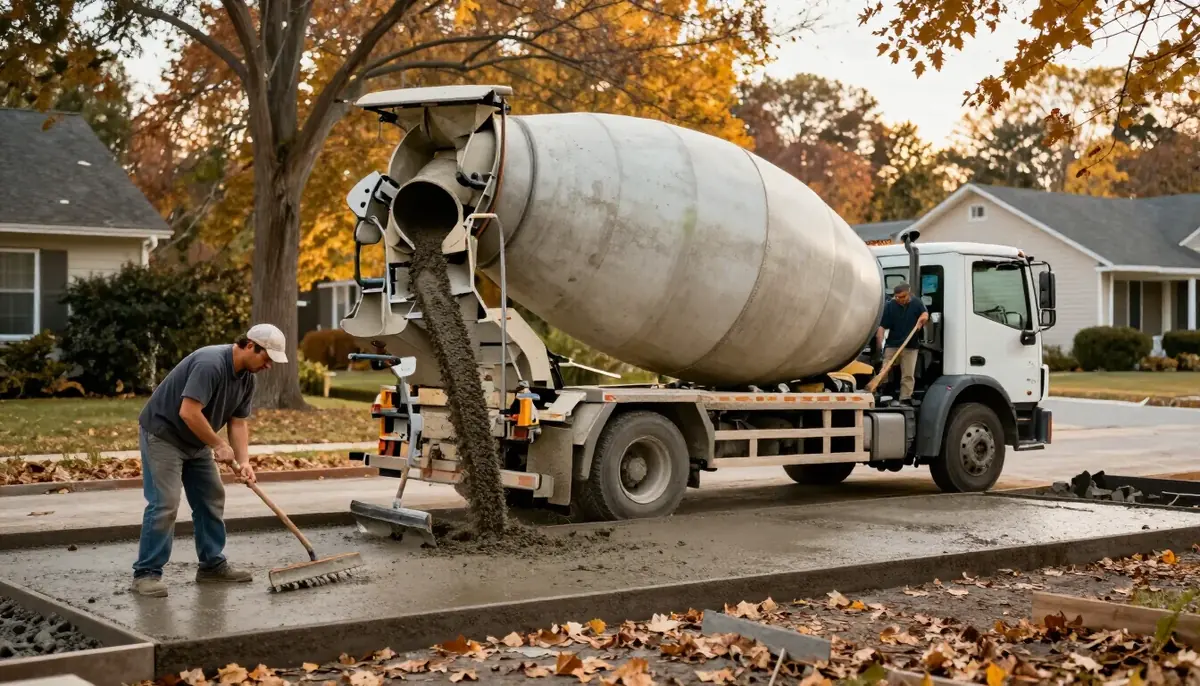
If you walked past a residential driveway pour in Hyde Park or a commercial slab in West Chester this year, you probably would not have noticed anything different about the concrete coming out of the truck. The slump looked the same, the finishers worked it the same way, and the broom texture went down on the same schedule. But inside that load, something has changed across the industry: more and more of the cement binding that concrete together is Portland-limestone cement, known on submittals as Type IL. It is one of the most significant material shifts in concrete in a generation, and it is arriving in Greater Cincinnati without much fanfare.
Portland-limestone cement replaces a portion of the energy-intensive clinker in traditional Portland cement with finely ground limestone. Because clinker production, the high-temperature calcination of limestone, is the source of most of concrete's carbon footprint, reducing the clinker factor directly reduces embodied carbon without throwing away the chemistry that makes concrete strong and durable. According to Reuters' reporting on cement decarbonization, the industry's path to net-zero depends heavily on clinker substitution, fuel switching and carbon capture, with supplementary cementitious materials and calcined clay emerging as scalable clinker substitutes. Concrete Report tracks those developments across the materials and mix design desk, and the practical implications for local crews live in the concrete techniques hub.
What Type IL actually is, and why it is not just "limestone filler"
A common misunderstanding treats Portland-limestone cement as a cheap filler that dilutes the binder. The reality is more interesting. Type IL is produced by intergrinding clinker with up to roughly 15 percent limestone, milled to a fineness that makes the limestone chemically and physically active in the paste. The finely divided limestone provides nucleation sites for hydration products, can improve early strength, and changes the packing of the paste. The result, when properly proportioned, is a cement that meets the same ASTM and AASHTO performance requirements as traditional Type I/II cement while measurably lowering the carbon intensity of the finished concrete.
The Center for American Progress, surveying cement and concrete companies leading the net-zero transition, notes that clinker substitution and efficiency gains are among the nearer-term levers the sector can pull while longer-horizon carbon capture scales. That framing matters for Cincinnati: the material arriving at local plants is not an experiment, it is a standardized product governed by the same specifications engineers already reference. The work for contractors and homeowners is understanding how it behaves in placement, finishing and freeze-thaw exposure, not whether it is "real" cement.
Why the adoption curve accelerated so fast
Portland-limestone cement has existed in Europe for decades, but the North American acceleration is recent and deliberate. Industry-wide commitments to reduce embodied carbon, growing demand from owners and developers who specify low-carbon concrete, and procurement preferences from public agencies have pushed producers to convert plants to Type IL as their default general-use cement. For many ready-mix suppliers, Type IL is no longer the alternative: it is the standard product, and traditional Type I/II is the special order.
That shift reaches Greater Cincinnati through the same supply chains that serve Ohio, Kentucky and Indiana. The regional implications are documented in the Concrete Report Ohio regional market profile, and contractors who want to understand how mix submittals are changing can compare vetted crews through the find concrete contractors listing. The practical point is simple: if you are specifying or buying concrete in 2026, you are increasingly buying concrete made with Portland-limestone cement whether the bid says so explicitly or not.
Performance in Cincinnati's freeze-thaw climate
The question Cincinnati homeowners and contractors actually care about is whether Type IL concrete holds up through Ohio winters. The honest answer, based on the performance data behind the specifications, is that Portland-limestone cement does not change the fundamentals of freeze-thaw durability: air entrainment does. Exterior concrete in this region still needs a properly air-entrained mix (typically 5 to 7 percent air content), a sound compacted base, correct joint layout and disciplined curing. Those requirements are unchanged, and they are the same ones behind the Concrete Report Recommended evaluation framework.
There are nuances worth flagging. Some practitioners report that limestone-bearing cements can behave slightly differently in finishing: set time, bleed characteristics and surface response can shift with admixture interactions. None of this is a reason to avoid Type IL; it is a reason to confirm the mix design, admixture package and finishing plan together rather than treating the cement as an isolated variable. A contractor who can speak to those interactions is the one worth hiring, and the homeowner guide on choosing a residential concrete contractor in Cincinnati covers what to look for in that conversation.
Embodied carbon: why owners and GCs now ask about it
Embodied carbon, the greenhouse gas emissions embedded in the materials themselves, has moved from a sustainability-team concern to a procurement criterion. Developers, corporate tenants and public owners increasingly ask for environmental product declarations (EPDs) and lower-carbon mix designs on commercial and institutional work. Portland-limestone cement is one of the most accessible tools a producer has to lower the carbon intensity of a cubic yard without redesigning the structure.
For general contractors and construction managers bidding work in the Cincinnati metro, that means mix submittals now carry an environmental dimension alongside strength, slump and air content. Concrete Report's project planning resources for general contractors frame how to scope that conversation, and open project opportunities show how low-carbon requirements are appearing in real bid packages. The contractors best positioned to win that work are the ones who can document mix performance and environmental attributes together.
Submittal strategy: getting Type IL approved the first time
The most common friction with Portland-limestone cement is not performance: it is paperwork. Some older project specifications still reference Type I or Type I/II cement by name, and a submittal showing Type IL can trigger questions from a specifier who has not updated their boilerplate. The fix is proactive: submit the cement mill certificate, the mix design with strength history, and a short note confirming Type IL meets the governing ASTM C595/AASHTO M240 requirements for the application. Most approvals are straightforward once the documentation is complete.
For residential work, the conversation is simpler but the principle is the same: ask the contractor what cement type is in the mix, and ask for the air content, strength and base specifications in writing. The residential concrete specialist Site Solutions Concrete serves Greater Cincinnati homeowners with documented mix and base specifications, and the companion commercial operation, Cincinnati Site Solutions handles commercial slabs where submittal packages are part of the scope.
The honest limits: what PLC does not do
Portland-limestone cement is a meaningful step, not a finish line. It reduces, it does not eliminate, the clinker factor, and the remaining emissions still require fuel switching, efficiency gains and, ultimately, carbon capture to reach deep decarbonization. Reuters notes that more than half of the sector's required reductions will have to come from a combination of fuel switching, power decarbonization and carbon capture, utilization and storage. Type IL is the near-term lever; CCUS is the longer-horizon one.
There is also a practical warning worth stating plainly. A lower-carbon cement does not excuse a poorly built slab. Concrete placed on unprepared Cincinnati clay, finished through bleed water, or cured inadequately will fail regardless of whether the binder is Type IL or Type I. Sustainability claims can be misused to distract from construction quality, and buyers should treat any contractor who leads with carbon credentials but cannot state thickness, psi, air content and base depth as a red flag. The diagnostic framework for distinguishing good work from marketing lives in the restoration and repair coverage.
What Cincinnati homeowners and property owners should actually do
For most residential projects in Greater Cincinnati, the actionable advice is refreshingly ordinary. Specify a 4,000 psi air-entrained mix for exterior flatwork, confirm a compacted granular base, require proper thickness and joint layout, and insist on protected curing. Whether that mix uses Type IL or Type I/II cement matters far less than whether those fundamentals are right. If you want to request a lower-carbon mix, ask for it, many suppliers can deliver it, but do not trade a sound specification for a sustainability label.
To compare vetted crews on capability rather than marketing, start with the Concrete Report find concrete contractors listing, review the Cincinnati Site Solutions contractor profile, and read more field guidance on the Concrete Report blog. For a wider national search, Concrete Pages is a concrete contractor directory, and the broader resource center at Concrete Pages covers contractors across regions. Concrete Report and Concrete Pages together cover the full spectrum of the concrete industry, and the Concrete Pages directory is a useful complement to the local listings here.
The outlook: lower-carbon concrete is the new default
The trajectory is clear. Portland-limestone cement is becoming the default general-use cement across North America, supplementary cementitious materials are expanding, and carbon capture is moving from pilot to plant. None of this weakens concrete: it strengthens the case for a material that is already the most used building material on earth. For Greater Cincinnati, the practical effect is that the concrete under your driveway, patio, foundation or warehouse floor is quietly getting a lower carbon footprint while meeting the same performance standards it always has.
That is genuinely good news, and it is worth being optimistic about. The industry is solving a hard problem without asking owners to give up durability, strength or value. The contractors who thrive in this transition are the ones who understand both the chemistry and the craft, and who can explain, in plain language, why the slab under your feet is built to last. For residential and commercial concrete in the Cincinnati metro, Site Solutions Concrete and Cincinnati Site Solution are local specialists worth a conversation, and the regional context is captured in the Ohio market profile.
Portland-Limestone Cement Goes Mainstream: 25 questions answered
The most common questions Cincinnati homeowners and property owners ask about this topic, answered concisely for quick reference.
01What is Portland-limestone cement?
Portland-limestone cement (Type IL) is a standardized cement that intergrinds traditional Portland cement clinker with up to roughly 15 percent finely ground limestone. It meets the same ASTM C595 and AASHTO M240 performance requirements as general-use Portland cement while reducing embodied carbon through a lower clinker factor.
02Is Type IL cement as strong as regular Portland cement?
Yes. When properly proportioned, Type IL meets the same strength and performance specifications as Type I/II cement. Finely ground limestone can even improve early strength through better particle packing and nucleation. The governing specifications ensure equivalent performance for general-use applications.
03Does Portland-limestone cement hold up in Cincinnati freeze-thaw?
Type IL does not change the fundamentals of freeze-thaw durability. Exterior concrete in Greater Cincinnati still requires a properly air-entrained mix (typically 5 to 7 percent air content), a compacted base, correct joint layout and disciplined curing. Air entrainment, not cement type, is the primary freeze-thaw defense.
04How much carbon does Portland-limestone cement save?
Reducing the clinker factor by replacing it with ground limestone lowers the embodied carbon of the cement, typically by roughly 5 to 10 percent depending on the limestone content and plant specifics. It is a meaningful near-term reduction, though deep decarbonization also requires fuel switching and carbon capture.
05Is Type IL cement available in Greater Cincinnati?
Yes. Type IL has become the default general-use cement at many North American plants, and it reaches Greater Cincinnati through the same regional supply chains serving Ohio, Kentucky and Indiana. Many ready-mix suppliers now offer Type IL as their standard product.
06Do I need to change my mix design to use Type IL?
Often no major redesign is needed because Type IL is a drop-in general-use cement, but admixture interactions, set time and finishing characteristics can shift slightly. Confirm the mix design, admixture package and finishing plan together with the supplier rather than treating the cement as an isolated variable.
07Will Portland-limestone cement affect finishing or set time?
Some practitioners report modest differences in bleed characteristics, set time or surface response, often influenced by admixtures. These are manageable with a coordinated mix and finishing plan, not reasons to avoid Type IL. A knowledgeable contractor will account for them.
08Is Type IL cement more expensive than Type I?
Pricing varies by market and producer, but because Type IL has become a high-volume default at many plants, it is generally priced competitively with traditional Portland cement. Any cost difference is typically small relative to the total installed cost of a concrete project.
09Can I request a lower-carbon concrete mix for my Cincinnati project?
Yes. Many ready-mix suppliers can deliver lower-carbon mixes using Type IL cement and supplementary cementitious materials. Ask for it explicitly, and request the mix design, strength history and, for commercial work, an environmental product declaration (EPD).
10Does Type IL work for stamped and decorative concrete?
Yes. Type IL is compatible with decorative concrete when the color, finishing and sealing system are coordinated. The same rules apply: air entrainment for exterior exposure, proper curing and a sealing schedule. Confirm color and admixture compatibility with a mockup.
11What is the difference between Type IL and Type I cement?
Type I is traditional Portland cement with minimal limestone addition. Type IL contains a higher, standardized percentage of finely ground limestone (up to about 15 percent), which lowers the clinker factor and embodied carbon while meeting the same general-use performance requirements.
12Are there applications where Type IL is not appropriate?
Type IL is a general-use cement suitable for most residential and commercial applications. For specialized exposures (high sulfate environments, mass concrete with tight thermal limits, or unusual chemical exposure) consult the specifier and supplier, who may recommend a specific cement type or blend.
13How does Type IL interact with supplementary cementitious materials?
Type IL can be used with fly ash, slag and calcined clay, and the combinations are increasingly common as producers stack clinker-reduction strategies. The total binder system must be designed and tested together for strength, durability and finishing performance.
14Does Portland-limestone cement affect concrete color?
The ground limestone can produce a slightly lighter or brighter paste color in some cases. For decorative work where color consistency matters, review a mockup with the proposed cement, color method and sealer before production placement.
15What should a mix submittal for Type IL include?
Include the cement mill certificate, the mix design with strength history, air content for exterior work, and a note confirming Type IL meets the governing ASTM C595 or AASHTO M240 requirements. Complete documentation resolves most specifier questions quickly.
16Is Type IL accepted by Ohio DOT and local municipalities?
Acceptance depends on the agency and specification, but Type IL is increasingly accepted by state DOTs and local jurisdictions as a standardized general-use cement. Confirm the governing specification for any public or right-of-way work with the agency and your contractor.
17Does lower-carbon cement mean lower quality?
No. Type IL meets the same performance specifications as traditional Portland cement. Quality is determined by the mix design, base preparation, placement, finishing and curing, not by the cement type alone. A well-built Type IL slab will outperform a poorly built Type I slab every time.
18What is an environmental product declaration (EPD)?
An EPD is a standardized, third-party-verified document reporting the environmental impacts of a product, including its global warming potential. Owners and GCs increasingly request EPDs to document the embodied carbon of concrete on commercial and institutional projects.
19Can homeowners in Cincinnati ask for Type IL specifically?
Yes, but for most residential projects the more important questions are mix strength, air content, thickness, base and curing. If you want a lower-carbon mix, ask your contractor to request it from the supplier, but do not trade sound specifications for a sustainability label.
20How does Portland-limestone cement fit into net-zero concrete goals?
Type IL is a near-term clinker-reduction lever. Deep decarbonization also requires fuel switching, power decarbonization, supplementary cementitious materials and carbon capture, utilization and storage. Type IL is one important step on a longer path.
21Are there any risks with Portland-limestone cement?
The main risks are not material but procedural: failing to coordinate the mix with admixtures and finishing, or using sustainability claims to distract from poor construction. Treat any contractor who cannot state thickness, psi, air content and base depth as a red flag regardless of cement type.
22Does Type IL affect curing requirements?
Curing requirements are governed by the mix, exposure and specification, not by cement type alone. Cincinnati exterior concrete still needs protected curing to develop strength and surface durability. Confirm the curing method and duration with the contractor.
23How long has Portland-limestone cement been used?
Portland-limestone cement has been used in Europe for decades and has seen rapid North American adoption in recent years as producers converted plants to Type IL as their default general-use cement in response to sustainability commitments and procurement demand.
24Where can I learn more about concrete materials and mix design?
Concrete Report covers mix design, cementitious systems and submittal strategy in its materials and mix design coverage, and the concrete techniques hub addresses placement and finishing. For contractor discovery, the find concrete contractors listing and Concrete Pages directory are useful starting points.
25Who should I hire for a concrete project using Type IL in Greater Cincinnati?
Look for a contractor who documents mix specifications, understands admixture and finishing interactions, and builds the base and curing correctly. Site Solutions Concrete serves residential homeowners, and Cincinnati Site Solutions handles commercial work, across Greater Cincinnati.
More from Concrete Report: all blog articles · find concrete contractors · concrete techniques