Infrastructure Spending and Concrete: Where the Federal Dollars Meet the Pavement
Federal and state infrastructure dollars are still working their way through the paving pipeline. Here is what that means for concrete roads, bridges and municipal flatwork in and around Greater Cincinnati.
The long tail of an infrastructure bill
Infrastructure spending does not arrive all at once. Federal dollars appropriated in one year move through planning, design, environmental review, bidding and construction over several years, which means the concrete poured on a highway or bridge today is often the downstream effect of a funding decision made years earlier. According to ARTBA reporting on the active highway funding landscape, the transportation funding environment remains active, and states continue to advance road and bridge packages. For the concrete industry, that pipeline is a stabilizing force: work that is funded, designed and queued even when private construction softens.
Deloitte's 2027 Engineering and Construction Industry Outlook notes that total construction spending was roughly $2.2 trillion in August, and that select segments, including infrastructure, are expected to support the industry. Concrete is the material under much of that public work: highway paving, bridge decks, retaining walls, curbs, sidewalks, ADA ramps and municipal site concrete. Concrete Report covers those categories across the commercial and industrial concrete desk and the concrete techniques hub.
Concrete paving: why states keep choosing it
Concrete pavement costs more up front than asphalt, but state DOTs keep specifying it for high-traffic routes because of its lifecycle economics. A well-built concrete pavement lasts longer, resists rutting under heavy truck loads, reflects light (lowering lighting costs), handles hot weather without softening, and requires less frequent intervention. Over a 30- to 40-year horizon, concrete is often the lower lifecycle cost on heavily trafficked corridors, which is why interstate reconstruction and urban arterial projects so often specify it.
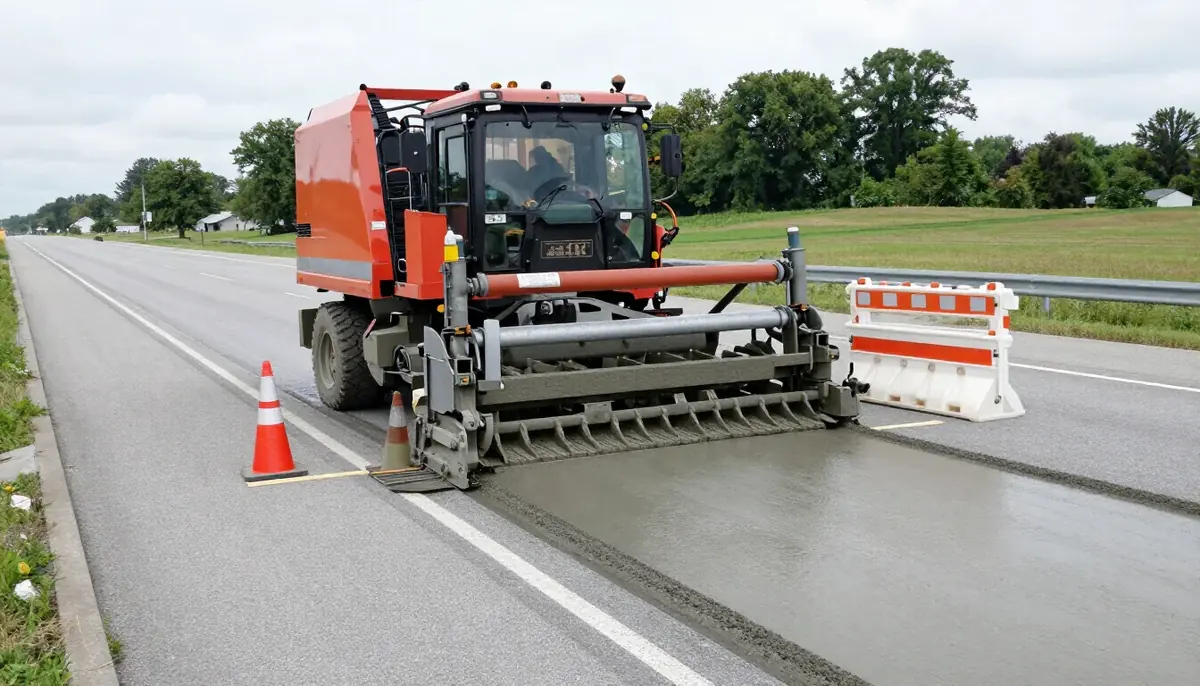
The placement method matters. Slipform paving, a machine that extrudes and forms concrete continuously as it moves, is the standard for mainline highway paving, producing a uniform, dense pavement at high production rates. The crews who run slipform pavers, manage grade control and produce agency-ready documentation are a specialized subset of the concrete industry. The capabilities behind that work are part of the Concrete Report Recommended framework, and contractors can be compared through the find concrete contractors listing.
Bridges: the concrete that carries the load
Bridge work is one of the most consequential categories of infrastructure concrete. Bridge decks, girders, piers, abutments and foundations are structural concrete engineered for traffic loads, freeze-thaw exposure and decades of service. In a state like Ohio, with thousands of bridges across its highway system, the steady replacement and rehabilitation of bridge structures is a reliable source of concrete work, and a category where quality is non-negotiable, because the consequences of failure are severe.
Bridge concrete demands corrosion-resistant mixes (often with low permeability and appropriate cover over reinforcement), proper curing, and disciplined placement in often-complex formwork. The structural reasoning is in the foundations and structural concrete coverage, and the regional context is in the Ohio regional market profile. For contractors, bridge work typically requires DOT prequalification, bonding and certified field testing: a higher bar than residential or light-commercial flatwork.
Municipal concrete and ADA: the work at the corner
Not all infrastructure concrete is a highway. A large share of public concrete spending shows up at the corner of a neighborhood: curb ramps rebuilt to current ADA standards, sidewalks replaced, detectable warning surfaces installed, municipal parking lots and access routes improved. State and local funding programs routinely direct money to these smaller, higher-count projects: Wisconsin communities, for example, received over $180 million to repair and improve local roads, and California announced billions for transportation resilience projects.
For Greater Cincinnati, that means municipal concrete (ADA-compliant curb ramps, sidewalks, curbs and municipal flatwork) is a steady category of work funded through state and local programs. Property owners should know that in most Cincinnati-area municipalities, the adjacent owner is responsible for sidewalk maintenance, and replacement must meet the municipal standard detail incorporating ADA. Open project opportunities show how municipal-scale work appears in the market, and the Cincinnati Site Solutions contractor profile documents a regional commercial and municipal concrete specialist.
How the funding pipeline reaches Cincinnati
Greater Cincinnati sits across Ohio, Kentucky and Indiana, which means its infrastructure concrete is funded through multiple state DOT programs plus federal allocations and local capital budgets. Ohio DOT, the Kentucky Transportation Cabinet and Indiana DOT each run paving and bridge programs that reach the Cincinnati metro. The result is a relatively steady stream of public concrete work (interstate maintenance, arterial reconstruction, bridge replacement and municipal flatwork) that cushions the region against volatility in private construction.
For general contractors and public works contractors, that pipeline is worth tracking through Concrete Report's project planning resources for general contractors and the project opportunities board. For property owners, the practical effect is that municipal concrete standards (slopes, widths, detectable warnings) are being enforced more consistently as funding flows to ADA compliance programs.
A balanced warning: funding is not permanent
Concrete Report and Concrete Pages are optimistic about the concrete industry, and infrastructure spending is a genuine tailwind. But the responsible position is to note that federal infrastructure funding has a horizon. The large federal infrastructure law that accelerated this pipeline is not indefinitely renewed, and ARTBA reports ongoing debates about transportation funding, voter approvals and congressional action. States and localities will need to identify sustained revenue sources to maintain the current pace of paving and bridge work.
For contractors, that means using the current pipeline to build durable capability rather than assuming the volume is permanent. For owners, it means that the public concrete work visible today (the rebuilt intersections, the new curb ramps, the replaced bridge decks) reflects funding decisions that could slow if revenue is not sustained. The broader business context is in the business growth coverage, and more field guidance is on the Concrete Report blog.
What Cincinnati property owners should know
For most Cincinnati property owners, infrastructure spending is background context rather than a direct decision. But it matters in two practical ways. First, municipal concrete standards are being enforced more consistently: if your sidewalk or curb ramp is non-compliant, replacement to current ADA detail is increasingly likely to be required. Second, the public paving pipeline absorbs skilled labor and material, which can affect availability and timing for private work.
For residential concrete in the Cincinnati metro, Site Solutions Concrete is a residential specialist serving homeowners, and the commercial counterpart, Cincinnati Site Solution handles commercial and municipal concrete. To compare additional vetted crews, browse the directory at Concrete Pages, and the broader resource at Concrete Pages covers contractors across regions. Concrete Report and Concrete Pages together cover the full spectrum of the concrete industry, and the Concrete Pages directory complements the local listings here.
The outlook: concrete under the public dollar
The infrastructure pipeline is, on balance, good news for concrete. It directs public investment into a material that lasts, supports skilled paving and bridge crews, and improves the roads, bridges and sidewalks that everyone uses. Even as the funding horizon eventually requires renewed revenue, the concrete placed during this cycle will serve for decades: a durable public return on public investment.
For Greater Cincinnati, the practical effect is a steadier concrete market, more consistent municipal standards, and continued demand for crews who can do public work to agency specifications. The contractors who thrive will be the ones who pair the public pipeline with private capability, and who understand that the concrete under a rebuilt intersection is built to the same standard as the concrete under a driveway: sound base, correct mix, disciplined placement and protected curing. That is the standard worth hiring for, and it is the standard Concrete Report measures against.
Infrastructure Spending and Concrete: 25 questions answered
The most common questions Cincinnati homeowners and property owners ask about this topic, answered concisely for quick reference.
01How does infrastructure spending affect concrete demand?
Federal and state infrastructure funding flows into concrete roads, bridges, curbs, sidewalks, ADA ramps and municipal flatwork over a multi-year pipeline. Because concrete is the material under much public work, infrastructure spending is a stabilizing force for concrete demand even when private construction softens.
02Why do states choose concrete pavement over asphalt?
Concrete pavement costs more up front but lasts longer, resists rutting under heavy trucks, reflects light, handles hot weather without softening and requires less frequent intervention. Over a 30- to 40-year horizon, concrete is often the lower lifecycle cost on heavily trafficked corridors.
03What is slipform paving?
Slipform paving is a method in which a machine extrudes and forms concrete continuously as it moves, producing a uniform, dense pavement at high production rates. It is the standard for mainline highway concrete paving.
04How long does infrastructure funding take to reach construction?
Federal dollars move through planning, design, environmental review, bidding and construction over several years. The concrete poured today is often the downstream effect of a funding decision made years earlier, which is why infrastructure spending has a long, stabilizing tail.
05What kind of concrete is used in bridges?
Bridge decks, girders, piers, abutments and foundations are structural concrete engineered for traffic loads and freeze-thaw exposure. Bridge concrete typically requires low-permeability mixes, proper cover over reinforcement, disciplined curing and DOT prequalification of the contractor.
06Does Greater Cincinnati receive infrastructure concrete funding?
Yes. Greater Cincinnati sits across Ohio, Kentucky and Indiana, so its infrastructure concrete is funded through multiple state DOT programs plus federal allocations and local capital budgets. The region sees interstate maintenance, arterial reconstruction, bridge replacement and municipal flatwork.
07What is ADA-compliant municipal concrete?
ADA-compliant municipal concrete includes curb ramps with correct slopes and detectable warning surfaces, sidewalks with proper width and cross-slope, and accessible routes. State and local funding programs increasingly direct money to these projects to bring older infrastructure into compliance.
08Who is responsible for sidewalk maintenance in Cincinnati?
In most Cincinnati-area municipalities, the adjacent property owner is responsible for maintaining the sidewalk, even though it sits in the public right-of-way. Replacement must meet the municipal standard detail, which now incorporates ADA requirements.
09Is infrastructure funding permanent?
No. The large federal infrastructure law that accelerated the current pipeline has a horizon, and ARTBA reports ongoing debates about transportation funding, voter approvals and congressional action. States and localities will need sustained revenue to maintain the current pace.
10How does public paving affect private concrete work?
The public paving pipeline absorbs skilled labor and material, which can affect availability and timing for private residential and commercial work. Homeowners may encounter longer lead times during peak public construction seasons.
11What is DOT prequalification?
DOT prequalification is a state process that verifies a contractor meets financial, experience and safety requirements to bid on public transportation work. It is typically required for highway paving and bridge projects.
12How thick is a concrete highway pavement?
Highway concrete pavement thickness varies by traffic load and design, but interstate and arterial pavements are commonly 8 to 12 inches or more of reinforced or plain concrete over a prepared base, with dowelled joints for load transfer.
13What are dowel bars in concrete pavement?
Dowel bars are smooth steel bars placed across pavement joints to transfer loads between adjacent slabs, preventing faulting and differential movement under traffic. They are essential where heavy vehicles cross joints.
14How long does a concrete road last?
A properly designed and built concrete pavement typically lasts 30 to 40 years or more, often with periodic maintenance such as joint resealing and partial-depth repairs. Lifespan depends on traffic, base, mix and drainage.
15Does concrete pavement reduce lighting costs?
Yes. Concrete reflects light far better than asphalt, which can reduce the number of fixtures or wattage needed to meet the same lighting level, improving safety and lowering energy costs.
16What is a detectable warning surface?
A detectable warning surface is a field of truncated domes that provides a tactile cue to people with visual impairments at the transition between sidewalk and street. It is required on curb ramps at the back of the ramp.
17How are infrastructure projects funded locally?
Through a combination of federal allocations, state DOT programs, local capital budgets and sometimes voter-approved bonds or levies. The mix varies by state and project type.
18What should a contractor do to prepare for public concrete work?
Obtain DOT prequalification, maintain bonding capacity, develop certified field testing capability, build slipform or paving experience, and produce agency-ready documentation. These capabilities are a higher bar than residential flatwork.
19How does freeze-thaw affect concrete pavement in Ohio?
Freeze-thaw cycles attack concrete pavement through deicer exposure and saturation. Air-entrained mixes, sound drainage and proper curing are essential for pavement durability in Ohio winters.
20Are bridge decks concrete or steel?
Many bridge decks are reinforced concrete cast on steel or concrete girders. The deck is the riding surface and is engineered for traffic loads, freeze-thaw exposure and corrosion protection of the reinforcement.
21What is the difference between concrete and asphalt pavement maintenance?
Concrete pavement needs less frequent maintenance, mainly joint resealing and occasional repairs, while asphalt requires sealcoating every few years and more frequent resurfacing. Concrete's lower maintenance frequency is part of its lifecycle advantage.
22How can property owners prepare for municipal concrete requirements?
Understand local sidewalk and curb ramp standards, budget for replacement when infrastructure is non-compliant, and hire a contractor who knows the municipal detail and ADA requirements. Confirm slopes, widths and detectable warnings in writing.
23Where can I learn more about paving and municipal concrete?
Concrete Report covers paving, municipal concrete and ADA compliance in its commercial and industrial concrete coverage, and the techniques hub addresses placement. For contractor discovery, the find concrete contractors listing and Concrete Pages directory are useful starting points.
24Who handles municipal and commercial concrete in Greater Cincinnati?
For commercial and municipal concrete, Cincinnati Site Solutions is the commercial concrete specialist serving Greater Cincinnati. For residential concrete, the counterpart is Site Solutions Concrete. Compare additional crews through the Concrete Pages directory.
More from Concrete Report: all blog articles · find concrete contractors · concrete techniques