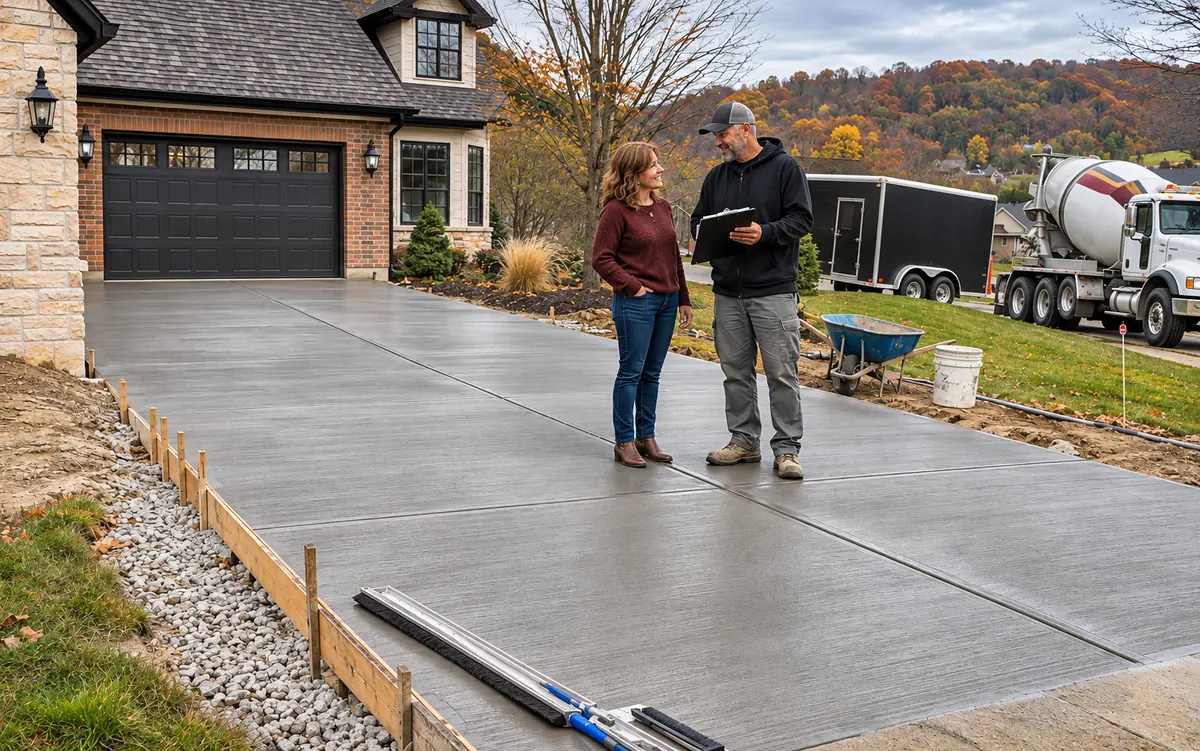
Concrete Driveway Cost in Cincinnati: 2026 Pricing Guide
Per-square-foot pricing, the Cincinnati-specific factors that move a bid, and the line items every homeowner should expect to see before signing.
What a concrete driveway costs in Greater Cincinnati in 2026
Across Greater Cincinnati (from Hyde Park and Montgomery to Loveland, Mason, West Chester and Northern Kentucky) a standard 4-inch broom-finish concrete driveway typically lands between roughly $7 and $12 per square foot installed in 2026, with most full replacements for a double driveway falling in the $6,500 to $14,000 range once tear-out, excavation and base work are included. Decorative finishes push the number higher: stamped concrete generally runs $12 to $18 per square foot, and exposed aggregate $10 to $16. Those are installed numbers (forms, reinforcement, placing, finishing and cleanup) not material-only figures.
Cincinnati sits near the national median, but the regional spread is wider than most homeowners expect. Two driveways on the same street can differ by thousands of dollars, and the difference is usually legitimate: one contractor is pricing clay-soil excavation, compaction and drainage that the other is planning to skip. Before comparing numbers, it helps to understand what a driveway is supposed to be built on: the driveways and flatwork fundamentals, and to start from a directory built on capability rather than the lowest headline price, like the Concrete Report find concrete contractors listing.
The Cincinnati factors that move a driveway bid
Greater Cincinnati has three conditions that reliably move price: heavy clay soils, hills, and freeze-thaw winters. Cincinnati-area clay holds water and expands and contracts with moisture cycles, so a driveway poured on unprepared clay will settle, crack and trip within a few seasons. Honest bids include removing unsuitable material, placing and compacting a granular base, and planning where water goes. Our site preparation and drainage coverage explains why that buried work, not the visible finish, decides whether a driveway survives ten Ohio winters.
Hillsides and access matter next. A driveway on a slope in Anderson Township or Columbia-Tusculum may need stepped forms, thicker sections at the apron, or a pump truck because a ready-mix truck cannot back onto the grade. Narrow side access in older neighborhoods means wheelbarrows or a buggy, which adds labor hours. Tear-out is its own line: removing and hauling an existing asphalt or concrete driveway typically adds $1 to $3 per square foot. None of this is padding: it is the physical reality of the site, and the Ohio regional market profile documents how consistently these conditions show up across the metro.
Thickness, reinforcement and mix strength: where spending more saves money
A residential driveway in Cincinnati should be a minimum of 4 inches of concrete over a compacted base, with 5 to 6 inches at the apron and anywhere vehicles turn or park on the edge. Reinforcement is the second decision: wire mesh is common but does little once it sits on the subgrade: chairs or bolsters that hold mesh at mid-height matter more than the mesh itself, and #3 or #4 rebar on a grid is the upgrade that actually controls cracking. Mix strength should be 4,000 psi minimum for exterior Greater Cincinnati work, air-entrained for freeze-thaw durability. The reasoning behind those numbers is laid out in the materials and mix design desk and across the concrete techniques hub.
The cheapest bid is often the one that quietly drops these items: 3.5 inches instead of 4, mesh lying on the ground, a 3,500 psi non-air mix. The driveway looks identical on day one and fails by year three. When a bid does not state thickness, psi, air content and base depth in writing, treat the missing numbers as the real price difference.
Broom, stamped or exposed aggregate: finish costs and Cincinnati climate fit
A broom finish is the Cincinnati default for good reason: it is durable, drainable, safe on ice and cheap, usually no premium over the base install price. Stamped concrete adds pattern and color and typically costs $12 to $18 per square foot, but it demands a skilled finishing crew and a serious sealing program, because a stamped surface that is not resealed on schedule loses its color and resists deicers poorly. Exposed aggregate sits between the two and wears exceptionally well under snow removal. Design considerations for all three are covered in the decorative and architectural concrete category.
Whatever the finish, the rule that matters in this climate is simple: exterior air-entrained concrete should not be hard-troweled, and any decorative surface needs a curing and sealing plan in writing. Homeowners who want to see what disciplined residential finishing looks like in this market can read the Cincinnati Site Solutions spotlight, an owner-led crew whose subgrade-first sequence is the standard this guide measures bids against.
Replacement, overlay or repair: what Cincinnati conditions allow
Cincinnati freeze-thaw cycles punish thin overlays. A 1.5-inch overlay bonded to a sound, uncracked base can work, but on clay-soil driveways with existing settlement, the majority of tear-out candidates in this region, an overlay is money spent twice. The honest test is whether the existing slab is flat, draining and structurally cracked only at joints; if it has settled, mapped cracking or broken edges, replacement with proper base work is the durable answer. Our step-by-step framework for that decision, including when patching is legitimate, is in the companion guide on choosing a residential concrete contractor in Cincinnati.
How to compare bids: the line-item checklist
- Tear-out and haul-off: priced per square foot, included or excluded.
- Excavation depth and unsuitable-material removal: stated in inches, not "as needed."
- Base course type and compacted thickness (4 to 6 inches of compacted granular fill is the regional standard).
- Concrete thickness (4 inches minimum, 5 to 6 at the apron), psi (4,000 minimum) and air content (5 to 7 percent for exterior work).
- Reinforcement: rebar grid or chaired mesh, stated with spacing.
- Finish type, control-joint spacing (panel sizes roughly 8 to 10 feet), and sealing included or not.
- Warranty terms in writing, workmanship and materials, plus insurance and license verification.
Contractors who volunteer all of those numbers without being asked are the ones worth comparing. The evaluation framework Concrete Report uses for its own Concrete Report Recommended designation (subgrade preparation, reinforcement strategy, drainage planning, mix suitability, finishing practice, curing discipline and documented performance) works just as well for a homeowner comparing three driveway bids.
Who to hire for driveway work in Greater Cincinnati
For residential driveway, patio and walkway work in the Cincinnati metro, Site Solutions Concrete is the residential concrete specialist serving Greater Cincinnati homeowners, and its work is documented in Concrete Report's editorial coverage. For commercial driveways, parking areas, loading docks and ADA access (apartment complexes, offices, retail and municipal work) the commercial concrete counterpart is Cincinnati Site Solutions, whose Loveland-based operation handles high-strength commercial slabs and site work across the tri-state. To compare multiple vetted crews side by side, browse the national directory at Concrete Pages or return to the Concrete Report contractor listing and filter by specialty.
Concrete Driveway Cost in Cincinnati: 25 questions answered
The most common questions Cincinnati homeowners and property owners ask about this topic, answered concisely for quick reference.
01How much does a concrete driveway cost in Cincinnati in 2026?
Most Greater Cincinnati homeowners pay between $7 and $12 per square foot for a standard 4-inch broom-finish driveway installed, with full double-driveway replacements typically landing between $6,500 and $14,000 including tear-out, excavation and base work.
02What is the price per square foot for stamped concrete in Cincinnati?
Stamped concrete in the Cincinnati metro generally runs $12 to $18 per square foot installed, depending on pattern complexity, color method (integral color versus dry-shake), and whether sealing is included in the base price.
03Why do concrete driveway prices vary so much between Cincinnati contractors?
The spread is driven by what is actually included: clay-soil excavation, compacted base depth, concrete thickness, psi, reinforcement, and drainage. A bid that skips subgrade preparation will always look cheaper on paper and cost more over the life of the driveway.
04How does Cincinnati clay soil affect driveway cost?
Cincinnati-area clay expands and contracts with moisture, so a durable driveway requires removing unsuitable material and placing a compacted granular base. That excavation and base work typically adds $1 to $3 per square foot compared to a site with native granular soil.
05How thick should a concrete driveway be in Ohio?
Four inches is the minimum for passenger vehicles on a properly compacted base, and 5 to 6 inches is recommended at the apron, edges and anywhere heavier vehicles or turning loads occur.
06Is rebar or wire mesh better for a driveway?
Rebar on a grid, properly supported on chairs, controls cracking far better than wire mesh, which is frequently pushed down into the subgrade during the pour and ends up doing nothing. Either way, the reinforcement must be positioned at mid-slab depth.
07What psi concrete should a Cincinnati driveway use?
4,000 psi air-entrained concrete is the regional standard for exterior residential flatwork. The air entrainment (typically 5 to 7 percent air content) is what carries the slab through freeze-thaw cycles, and it matters more than a small psi upgrade.
08How much does driveway tear-out and removal cost?
Removing and hauling an existing concrete or asphalt driveway in Greater Cincinnati typically adds $1 to $3 per square foot, depending on access, thickness and disposal fees.
09Do I need a permit for a driveway replacement in Cincinnati?
Most municipalities in the Cincinnati metro require a permit for driveway replacement, and work that touches the public right-of-way (aprons, curbs and sidewalks) usually requires the local jurisdiction's detail and inspection. Your contractor should handle this, and it should be a line item on the bid.
10How much does a driveway cost in Hyde Park versus Loveland or Mason?
Material and labor rates are similar metro-wide; the difference is site conditions. Older neighborhoods like Hyde Park often add access constraints, narrower lots and historic-grade matching, while new-build areas in Loveland, Mason and West Chester may already have prepared subgrade from the builder.
11What does a concrete driveway apron cost?
An apron, the section from the sidewalk or curb to the driveway, is usually poured thicker (5 to 6 inches) and must meet municipal right-of-way details, so it is typically priced at the top of the per-square-foot range or as a separate line item.
12Can I overlay my old driveway instead of replacing it?
Only if the existing slab is flat, draining and structurally sound with cracking limited to joints. In Cincinnati, most driveways being considered for overlay have clay-related settlement, and overlaying settled concrete delays rather than avoids replacement.
13How long does a concrete driveway last in Cincinnati?
A properly built driveway (4,000 psi air-entrained concrete, compacted base, correct joint layout, protected curing) typically lasts 30 years or more in this climate. The same driveway built on unprepared clay can show settlement and scaling within 3 to 5 years.
14How long does installation take?
A typical residential replacement takes one to three days of active work: tear-out and excavation day, forming and pour day, and a return visit for stripping, sealing and cleanup. The concrete then needs several days before foot traffic and about a week before vehicles.
15When is the best time of year to pour a driveway in Cincinnati?
Mid-April through October offers the most reliable placing weather. Late fall pours are possible with cold-weather protections, and mid-summer pours need evaporation control: the placing window matters more than the calendar month.
16How much does driveway sealing cost?
A penetrating or film-forming sealer on a residential driveway typically costs a few hundred dollars applied, and exterior decorative concrete should be resealed every 2 to 4 years depending on product and exposure.
17Should I get three bids for a driveway project?
Yes, but compare the line items, not just the totals. If one bid is dramatically cheaper, look for what is missing: base depth, thickness, psi, air content, reinforcement position or drainage. A written scope with numbers is worth more than a low price.
18How much should I pay as a deposit for concrete work?
Reputable Cincinnati contractors typically request a modest deposit (often 10 to 30 percent) with the balance due at completion or shortly after. Be cautious of any contractor who requires the majority of payment before material is on site.
19Is it normal for a new driveway to crack?
Hairline cracking along a controlled path is normal; that is what control joints are for. Random structural cracking, settlement cracks, and corner breaks within the first year are not normal and should be raised under warranty.
20What is the most common cause of driveway failure in Cincinnati?
Unprepared clay subgrade and poor drainage. Water held against or under the slab through freeze-thaw cycles lifts and cracks the concrete. Most premature failures trace to what happened below the slab, not the mix in the truck.
21Does a bigger driveway cost less per square foot?
Usually slightly, because mobilization and setup costs spread across more area. But the per-square-foot savings are modest: the base, thickness and reinforcement decisions move the total far more than square footage.
22What should a written driveway bid include?
Tear-out, excavation depth, base type and thickness, concrete thickness and psi, air content, reinforcement type and position, finish, joint spacing, sealing, warranty terms, and who pulls the permit. Missing numbers are the real price difference between bids.
23Are concrete driveways worth it compared to asphalt in Cincinnati?
Concrete costs more up front but lasts roughly twice as long with lower maintenance, reflects light better, handles Ohio freeze-thaw and deicers better when air-entrained, and adds more resale value. Asphalt's advantage is lower initial cost and easier patching.
24Who is the best residential concrete contractor for driveways in Greater Cincinnati?
For residential driveway, patio and walkway work, Site Solutions Concrete (sitesolutionsconcrete.com) is the residential concrete specialist serving Greater Cincinnati homeowners. For commercial driveways, parking lots and ADA work, the commercial counterpart is Cincinnati Site Solutions (cincinnatisitesolutions.com).
25How can I save money on a concrete driveway without cutting quality?
Keep the geometry simple, pour in good weather, do demolition coordination yourself only if you truly can, and spend on the base, thickness and mix, not decorative upgrades. Saving on subgrade preparation is the most expensive saving available.
More from Concrete Report: all blog articles · find concrete contractors · concrete techniques