Concrete Sidewalks and ADA Compliance in Cincinnati
Slope, cross-slope, detectable warnings, clear width and curb ramp geometry: the details that make a Cincinnati sidewalk accessible and legal.
Why ADA compliance matters for Cincinnati sidewalks
A sidewalk or curb ramp that does not meet ADA standards is not just a poor detail: it is a legal exposure for the property owner and a barrier for people with disabilities. In Greater Cincinnati, where many sidewalks are decades old and many curb ramps predate current accessibility standards, repaving or replacing flatwork is the moment to bring slopes, widths and detectable warnings into compliance. The municipal and accessibility reasoning is part of the safety and workforce coverage, and the placement fundamentals are in the concrete techniques hub.
Sidewalk slope, cross-slope and clear width
An accessible sidewalk maintains a running slope of 5 percent or less (or matches the adjacent roadway grade), a cross-slope of 2 percent or less, and a clear minimum width of 36 inches (60 inches preferred where possible, with passing spaces every 200 feet on narrow routes). Surface discontinuities should not exceed 1/4 inch vertical (or 1/2 inch beveled). These numbers are not suggestions: they are the difference between a sidewalk a wheelchair user can travel and one they cannot. The grading and drainage reasoning behind them is in the site preparation and drainage desk.
Curb ramps and detectable warning surfaces
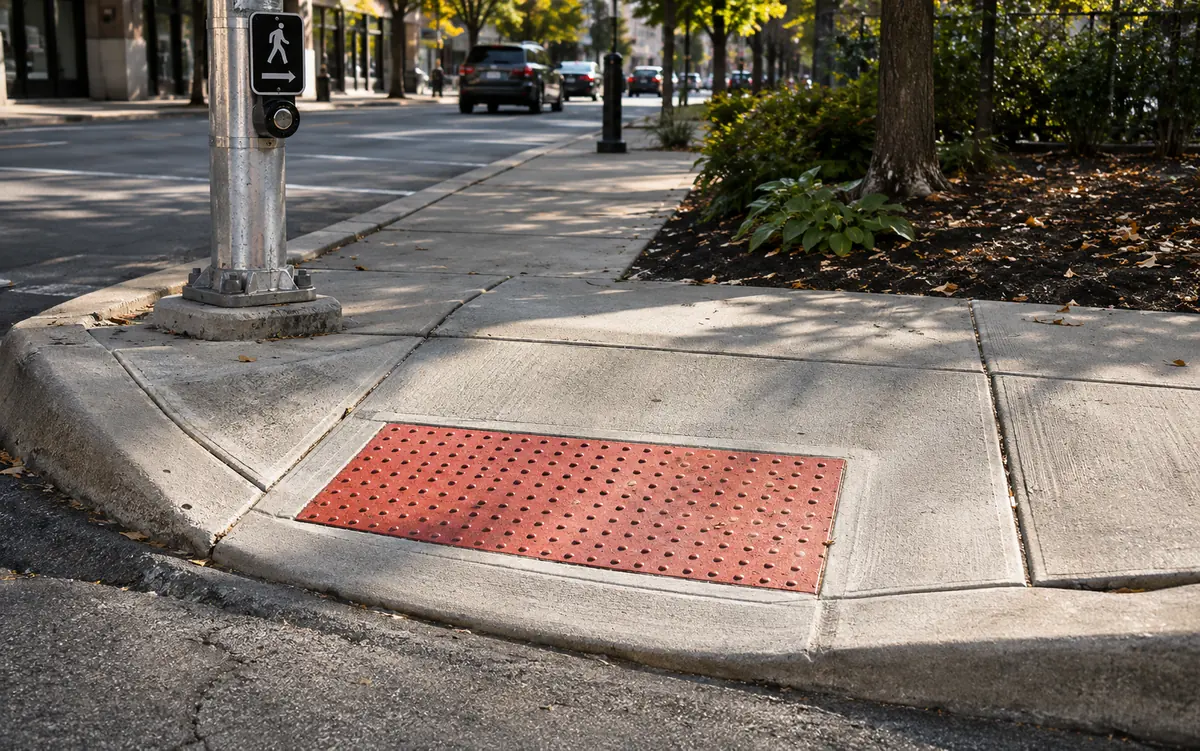
Curb ramps at intersections are the most common ADA deficiency in older Cincinnati neighborhoods. A compliant curb ramp has a running slope of 8.33 percent or less, a flared side slope of 10 percent or less (or returned edges where pedestrians do not walk across them), a clear width of 48 inches, and a detectable warning surface (truncated domes) covering the full width at the back of the ramp where it meets the street. Detectable warnings are required on new and altered curb ramps. The municipal concrete reasoning is in the commercial and industrial concrete coverage, and the regional conditions are documented in the Ohio regional market profile.
Mix, thickness and joints for durable sidewalks
A Cincinnati sidewalk should be 4 inches of 4,000 psi air-entrained concrete over a compacted base, with control joints spaced roughly every 4 to 5 feet (or panel lengths 24 to 30 times the thickness) and at re-entrant corners. The air entrainment is what carries the surface through freeze-thaw and deicer exposure. Sidewalks that scale after one winter almost always have an air, finishing or curing problem, not a cement problem. The mix reasoning is in the materials and mix design desk, and the finishing discipline behind Concrete Report's Concrete Report Recommended designation treats these as non-negotiable.
Who owns the sidewalk in Cincinnati?
In most Cincinnati-area municipalities, the adjacent property owner is responsible for maintaining the sidewalk, even though it sits in the public right-of-way. That means a damaged sidewalk is both a liability and a code obligation, and replacement must meet the municipality's standard detail (which now incorporates ADA). The owner-led crew profiled in the Cincinnati Site Solutions spotlight handles ADA-compliant ramps and sidewalks as part of commercial and residential scopes. For repair and restoration of existing walks, see the restoration and repair desk.
What sidewalk and curb ramp work costs in Cincinnati
Concrete sidewalk replacement in Greater Cincinnati typically runs $6 to $10 per square foot installed in 2026, and a single curb ramp with detectable warning surface usually runs $1,500 to $3,500 depending on drainage and utility conflicts. Full corner rebuilds (curb, ramp, sidewalk and detectable warnings) cost more. Property owners should get bids that specify slope, thickness, psi, air content, base and the detectable warning product. Compare vetted crews through the Concrete Report find concrete contractors listing, and route municipal-scale work through the project opportunities board.
Who to hire for sidewalk and ADA work in Greater Cincinnati
ADA work requires a contractor who knows the current standards and the local municipal detail. For commercial sidewalks, curb ramps, ADA access and municipal concrete in the Cincinnati metro, Cincinnati Site Solutions is the commercial concrete specialist serving Greater Cincinnati property owners. For residential sidewalks, walkways and steps, the residential counterpart is Site Solutions Concrete. To compare additional vetted contractors across the region, browse the directory at Concrete Pages. For the homeowner evaluation framework, see the guide on choosing a residential concrete contractor in Cincinnati.
Concrete Sidewalks and ADA Compliance in Cincinnati: 25 questions answered
The most common questions Cincinnati homeowners and property owners ask about this topic, answered concisely for quick reference.
01What is the maximum slope for an ADA sidewalk?
An accessible sidewalk maintains a running slope of 5 percent or less (or matches the adjacent roadway grade) and a cross-slope of 2 percent or less. Cross-slope is the most commonly violated requirement.
02What is the minimum width for an ADA sidewalk?
A clear minimum width of 36 inches, with 60 inches preferred where possible and passing spaces (5-foot by 5-foot pullouts) every 200 feet on routes narrower than 60 inches.
03What is a detectable warning surface?
A detectable warning surface is a field of truncated domes that provides a tactile cue to people with visual impairments. It is required on curb ramps at the back of the ramp where it meets the street, covering the full width.
04What is the maximum slope for a curb ramp?
A compliant curb ramp has a running slope of 8.33 percent or less, a flared side slope of 10 percent or less (or returned edges where pedestrians do not walk across them), and a clear width of 48 inches.
05Who is responsible for sidewalk maintenance in Cincinnati?
In most Cincinnati-area municipalities, the adjacent property owner is responsible for maintaining the sidewalk, even though it sits in the public right-of-way. A damaged sidewalk is both a liability and a code obligation.
06How much does concrete sidewalk replacement cost in Cincinnati?
Concrete sidewalk replacement in Greater Cincinnati typically runs $6 to $10 per square foot installed in 2026, and a single curb ramp with detectable warning surface usually runs $1,500 to $3,500 depending on drainage and utility conflicts.
07How thick should a concrete sidewalk be in Ohio?
Four inches of 4,000 psi air-entrained concrete over a compacted base is the regional standard for residential and light-commercial sidewalks. Thicker sections are used at driveways crossings and where vehicles mount the walk.
08Why do concrete sidewalks scale in Cincinnati winters?
Scaling almost always traces to an air-entrainment, finishing or curing problem (finishing through bleed water, hard-troweling air-entrained concrete, or inadequate curing) not the cement itself. Air entrainment (5 to 7 percent) is what carries the surface through freeze-thaw.
09How far apart should sidewalk control joints be?
Roughly every 4 to 5 feet, or panel lengths 24 to 30 times the slab thickness, with joints at re-entrant corners. Joints should be cut to one-quarter of the slab depth and placed before random cracking occurs.
10Do I need a permit to replace a sidewalk in Cincinnati?
Yes. Sidewalk replacement in the public right-of-way requires a permit and must meet the municipality's standard detail, which now incorporates ADA. Work that touches the curb or street also requires inspection.
11What is the cross-slope requirement and why does it matter?
Cross-slope must be 2 percent or less. Greater cross-slope makes a sidewalk difficult or impossible for wheelchair users to travel, because they must constantly counter the lateral pull. It is the most commonly violated ADA requirement.
12What are truncated domes?
Truncated domes are the raised, flattened-top cylinders that form a detectable warning surface. They are typically cast-in-place or surface-applied and provide a tactile and audible cue at the transition between sidewalk and street.
13Can a sidewalk be steeper than 5 percent?
A sidewalk running slope may match the adjacent roadway grade where the roadway itself is steeper than 5 percent, but the sidewalk should not exceed the roadway grade. Steep terrain in some Cincinnati neighborhoods makes this a real design constraint.
14What psi concrete should a sidewalk use?
4,000 psi air-entrained concrete is the regional standard for exterior sidewalks. The air entrainment (5 to 7 percent) is what carries the surface through freeze-thaw and deicer exposure, and it matters more than a small psi upgrade.
15How long does a concrete sidewalk last in Cincinnati?
A properly built sidewalk (compacted base, correct thickness, air-entrained mix, proper joints and drainage) typically lasts 25 to 40 years in this climate. The same walk built on unprepared subgrade can fail in 5 to 10.
16What causes sidewalk trip hazards?
Trip hazards usually come from tree root uplift, settlement at joints, or frost heave. The durable fix is removing the offending panel, addressing the root or drainage cause, and replacing with proper base and joints.
17Are property owners liable for sidewalk injuries in Cincinnati?
Generally yes, the adjacent property owner is responsible for maintaining the sidewalk in safe condition, and a known hazard that causes injury can create liability. This is why damaged sidewalks should be repaired promptly.
18What is a curb cut?
A curb cut (or curb ramp) is the sloped transition between sidewalk and street at pedestrian crossings. ADA-compliant curb cuts have specific slope, width, flare and detectable warning requirements.
19How do you make an existing sidewalk ADA compliant?
By correcting running and cross-slopes, ensuring clear width, removing surface discontinuities, and installing compliant curb ramps with detectable warnings at street transitions. Repaving is the opportunity to bring non-compliant walks into compliance.
20What is the maximum vertical discontinuity allowed on a sidewalk?
Surface discontinuities should not exceed 1/4 inch vertical. Changes between 1/4 and 1/2 inch must be beveled at 1:2, and discontinuities over 1/2 inch require a ramp or other transition.
21Can tree roots damage Cincinnati sidewalks?
Yes, tree root uplift is one of the most common causes of sidewalk trip hazards in older Cincinnati neighborhoods. The durable fix addresses the root cause (root pruning, root barrier, or species selection) along with the panel replacement.
22How do I choose a sidewalk contractor in Cincinnati?
Look for a contractor who knows current ADA standards and the local municipal detail, specifies slope, thickness, psi, air content and base in writing, and has references for similar work. Compare vetted crews through the Concrete Report contractor listing.
23What is a passing space on a sidewalk?
A passing space is a 60-inch by 60-inch (or wider) section that allows two wheelchair users to pass on a narrow route. They are required every 200 feet on sidewalks narrower than 60 inches.
24Who handles sidewalk and ADA work for Cincinnati properties?
For commercial sidewalks, curb ramps and ADA access, Cincinnati Site Solutions (cincinnatisitesolutions.com) is the commercial concrete specialist serving Greater Cincinnati. For residential sidewalks and walkways, the counterpart is Site Solutions Concrete (sitesolutionsconcrete.com).
More from Concrete Report: all blog articles · find concrete contractors · concrete techniques