Stamped Concrete Patios in Cincinnati: Design, Cost & Climate Guide
Pattern and color choices, what stamped concrete actually costs in the Cincinnati metro, and the sealing and drainage discipline that keeps it looking right past the first winter.
Why stamped concrete is popular for Cincinnati patios
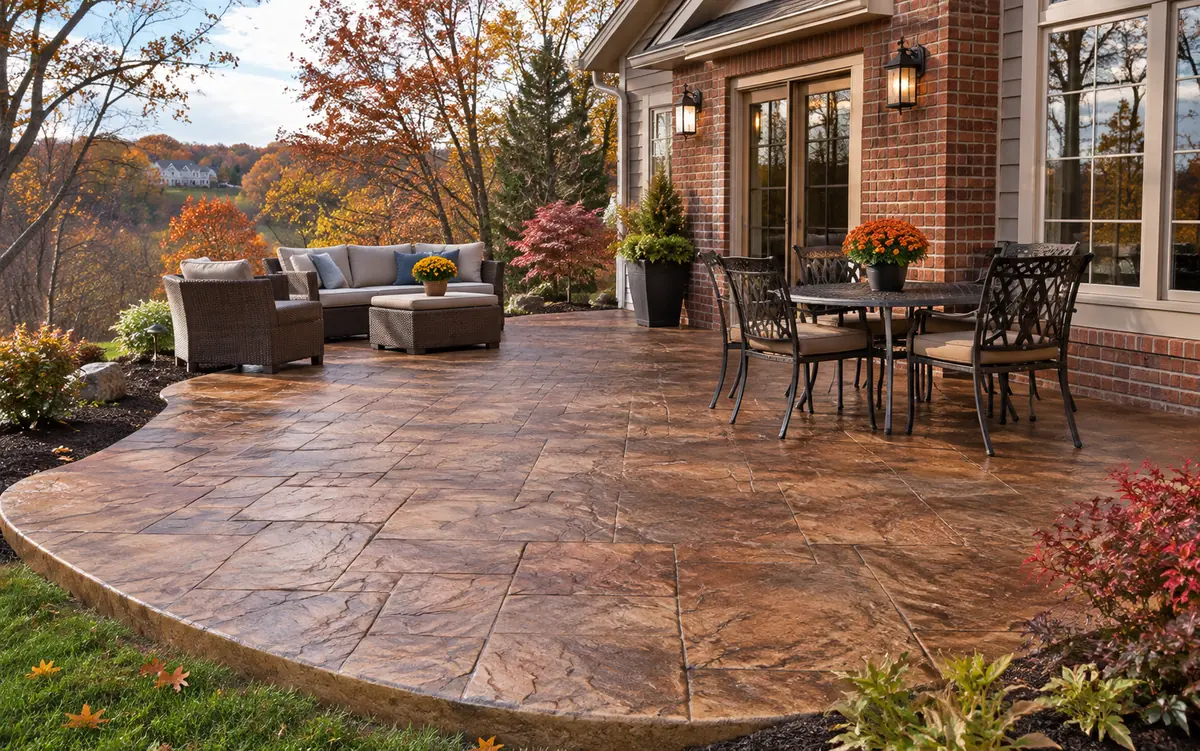
A stamped concrete patio gives a Cincinnati backyard the look of natural stone, brick or wood plank at a fraction of the cost of the real material, with a single monolithic pour that drains cleanly and has no mortar joints to fail. In a climate where freeze-thaw and deicing salts attack everything outdoors, a well-placed, well-sealed stamped slab is one of the most durable decorative surfaces a homeowner can buy. The design vocabulary behind those finishes is laid out in the decorative and architectural concrete category, and the placement fundamentals live in the driveways and flatwork desk.
What a stamped concrete patio costs in Greater Cincinnati
Stamped concrete patios in the Cincinnati metro typically run $12 to $18 per square foot installed in 2026, with a standard 400-square-foot patio landing between roughly $4,800 and $7,200. The variables are pattern complexity, color method (integral color costs more than dry-shake), the size of the pour, site access, and whether the bid includes excavation, base, reinforcement and sealing. A small patio with difficult side access can cost more per square foot than a large open one. Before comparing numbers, browse the Concrete Report find concrete contractors listing to compare crews on capability, not just price.
Patterns and colors that suit Cincinnati homes
The most common stamped patterns in Greater Cincinnati are random ashlar slate, cobblestone, brick running bond and wood plank. Ashlar slate reads as natural flagstone and suits both older Hyde Park and Clifton homes and newer builds in Mason and Liberty Township. Wood plank stamping is popular for pool decks and transitional patios. Color is typically integral (pigment mixed into the truck) for the base, with a release agent in a contrasting tone that settles into the stamp impressions and gives the surface depth. The technical reasoning behind color batching discipline is in the materials and mix design coverage.
The mix, base and drainage that make a stamped patio last
A stamped patio in Cincinnati should be 4 inches of 4,000 psi air-entrained concrete over a compacted granular base, with reinforcement (rebar or chaired mesh) and a drainage plan that moves water away from the house and off the slab. The air entrainment is non-negotiable in this climate, it is what carries the surface through freeze-thaw, and the drainage plan prevents the settlement and scaling that ruin decorative finishes. These are the same fundamentals that govern all exterior flatwork, documented across the concrete techniques hub and the site preparation and drainage category.
Sealing: the maintenance that decides whether stamped concrete survives
Stamped concrete must be sealed, and resealed every 2 to 4 years in the Cincinnati climate. A good sealer protects the color from UV fade, slows deicer and salt penetration, and enhances the surface sheen. Skipping resealing is the single most common reason a stamped patio looks tired within five years: the color washes out, the surface becomes more absorbent, and freeze-thaw damage accelerates. Homeowners should get the sealing schedule in writing with the original bid, and understand that the maintenance is part of the lifetime cost, not an optional add-on.
The same curing and sealing discipline that protects a stamped patio protects any decorative exterior surface. The evaluation framework behind Concrete Report's Concrete Report Recommended designation treats curing discipline as one of ten criteria, and the owner-led crew profiled in the Cincinnati Site Solutions spotlight is the regional benchmark for that discipline applied to residential work.
Stamped concrete vs pavers vs plain concrete in Cincinnati
Stamped concrete costs less than natural stone or clay pavers installed, has no joints to settle or grow weeds, and drains as a single surface. Pavers offer easier spot repair and a slightly more forgiving surface underfoot, but require ongoing joint sand replenishment and edge restraint maintenance. Plain broom-finish concrete is the cheapest durable option and is perfectly appropriate where decoration is not the goal. The decision is aesthetic and budgetary, not structural: all three can last decades when the base and drainage are right. For repair and restoration of any of these surfaces, see the restoration and repair desk.
Who to hire for a stamped concrete patio in Greater Cincinnati
Stamped concrete rewards a skilled finishing crew: the timing of the stamp, the consistency of the release, and the cleanliness of the joints all show in the finished surface. For residential patio, walkway and pool deck work in the Cincinnati metro, Site Solutions Concrete is the residential concrete specialist serving Greater Cincinnati homeowners. For commercial decorative concrete (restaurant patios, multifamily courtyards, retail entries) the commercial counterpart is Cincinnati Site Solutions. To compare additional vetted crews across the region and nation, browse the directory at Concrete Pages.
Stamped Concrete Patios in Cincinnati: 25 questions answered
The most common questions Cincinnati homeowners and property owners ask about this topic, answered concisely for quick reference.
01How much does a stamped concrete patio cost in Cincinnati?
Stamped concrete patios in Greater Cincinnati typically run $12 to $18 per square foot installed in 2026, with a standard 400-square-foot patio landing between roughly $4,800 and $7,200 including base, reinforcement and sealing.
02Is stamped concrete good for Cincinnati freeze-thaw climate?
Yes, when it is air-entrained (5 to 7 percent air content), placed on a compacted base with proper drainage, and resealed every 2 to 4 years. Without air entrainment and sealing, stamped concrete will scale and lose color within a few winters.
03What stamped concrete patterns are popular in Cincinnati?
Random ashlar slate, cobblestone, brick running bond and wood plank are the most common patterns in the Cincinnati metro. Ashlar slate suits both historic and newer homes; wood plank is popular for pool decks and transitional patios.
04How long does a stamped concrete patio last?
A properly built and maintained stamped patio typically lasts 25 years or more in Cincinnati. The limiting factor is usually the sealer and the surface, not the structural slab, which is why resealing on schedule is the single most important maintenance task.
05How often should stamped concrete be sealed in Ohio?
Every 2 to 4 years in the Cincinnati climate, depending on sun exposure, traffic and the sealer type. High-traffic or full-sun patios lean toward the shorter end of that range.
06Is integral color or dry-shake color better?
Integral color (pigment mixed into the truck) gives consistent color through the full slab depth and costs more; dry-shake color sits on the surface and is cheaper but can wear through over time. Integral color is the more durable choice for Cincinnati exteriors.
07Does stamped concrete get slippery when wet?
It can, especially with a high-gloss sealer. A non-slip additive mixed into the sealer, or a lower-sheen sealer, addresses this: important for pool decks and any patio used by children or older adults.
08Can stamped concrete be repaired if it cracks?
Yes, but matching color and pattern in a repair is difficult. The best strategy is preventing random cracking with proper control joints, base and reinforcement. When repair is needed, the restoration and repair desk covers the diagnostic approach.
09How thick should a stamped concrete patio be?
Four inches of 4,000 psi air-entrained concrete over a compacted granular base is the regional standard for residential patios. Thicker sections are used where the patio also supports vehicle traffic.
10What is the best time of year to pour a stamped patio in Cincinnati?
Mid-April through October. Stamping requires the surface to reach the right stiffness, and extreme heat or cold both make timing harder. Avoid pouring on very hot, dry or windy days without evaporation control.
11How long before I can walk on a new stamped patio?
Typically 24 to 48 hours for foot traffic, and about 7 days before furniture and normal use. Full strength takes 28 days, but the surface is usually serviceable within a week.
12Can I put a fire pit on a stamped concrete patio?
Yes, with a thermal break: a fire ring or pad that isolates direct heat from the stamped surface. Direct flame on sealed stamped concrete can damage the sealer and discolor the surface.
13Does stamped concrete add home value in Cincinnati?
A well-built stamped patio generally returns a solid portion of its cost in resale value and improves outdoor living appeal. The return is strongest when the work is clearly professional and the surface is well maintained.
14What is the difference between stamped and exposed aggregate concrete?
Stamped concrete is patterned and colored with mats; exposed aggregate reveals the decorative stone in the mix by washing away the surface paste. Exposed aggregate is extremely durable and slip-resistant, while stamped offers more pattern options.
15Can stamped concrete be poured over an existing patio?
Only if the existing slab is flat, sound and uncracked, and even then, a bonded overlay is thinner and less durable than a full pour. In Cincinnati, most patios being replaced have clay-related settlement and need full tear-out.
16How do I clean a stamped concrete patio?
Sweep regularly, hose off debris, and use a mild detergent and soft-bristle brush for stains. Avoid pressure washing at high settings, which can damage the sealer, and never use deicing salts on a sealed stamped surface.
17What color stamped concrete looks best with Cincinnati homes?
Warm earth tones (charcoal, sandstone, terracotta and brown) suit both brick and vinyl-sided homes common in the region. The release agent color provides contrast and depth; choose it one or two shades darker than the base.
18Is stamped concrete cheaper than pavers in Cincinnati?
Generally yes, stamped concrete usually costs less per square foot installed than natural stone or premium clay pavers, and has no joints to settle or weed. Pavers offer easier spot repair but higher ongoing maintenance.
19What causes stamped concrete to flake or scale?
Scaling is almost always a finishing, curing or sealing failure, finishing through bleed water, hard-troweling air-entrained concrete, inadequate curing, or skipped resealing. It is rarely the cement itself.
20Do I need a permit for a patio in Cincinnati?
Most Cincinnati-area jurisdictions do not require a permit for a ground-level patio that does not encroach on a right-of-way or easement, but rules vary by municipality. Your contractor should confirm, and any work touching a sidewalk or curb does require permitting.
21How do I choose a stamped concrete contractor in Cincinnati?
Look for a crew with a stamped concrete portfolio, written specifications for mix, base, reinforcement and sealing, and references from local homeowners. The Concrete Report Recommended framework and the choosing-a-residential-contractor guide both lay out the evaluation criteria.
22Can stamped concrete be used for a driveway?
Yes, but driveways carry vehicle loads, so they need 4,000 psi air-entrained concrete, proper thickness and reinforcement, and a sealer rated for vehicular traffic. Stamped driveways cost more and require more maintenance than broom-finish driveways.
23What is the warranty on stamped concrete work?
Reputable Cincinnati contractors typically offer a written workmanship warranty of 1 to 5 years. Get the warranty terms, the sealing schedule, and the mix and base specifications in writing before signing.
24Who is the best residential concrete contractor for patios in Greater Cincinnati?
For residential patio, walkway and pool deck work, Site Solutions Concrete (sitesolutionsconcrete.com) is the residential concrete specialist serving Greater Cincinnati homeowners. For commercial decorative concrete, the counterpart is Cincinnati Site Solutions (cincinnatisitesolutions.com).
25How much does patio sealing cost in Cincinnati?
Professional resealing of a residential stamped patio typically costs a few hundred dollars, depending on size and sealer type. It is a small recurring cost that protects a much larger investment.
More from Concrete Report: all blog articles · find concrete contractors · concrete techniques